
Start Here: What Mixed Weeds Really Mean
If your yard is a patchwork of dandelions, crabgrass, clover, and plants you cannot name, you are not alone. Different weeds show up for different reasons. Some like compacted soil. Others thrive in soggy spots or areas that bake in the sun. When you learn what each weed is telling you about your lawn, you can build a targeted weed control plan that works fast and keeps working. At The Doctors of Landscaping in Kenosha, Wisconsin, we help homeowners read these signs and fix the root causes, not just the symptoms.
Weed control starts here. In this guide, you will learn why different weeds invade your yard, what they signal about your soil, and how to correct the conditions they love. You will also get a simple, step-by-step plan for long-term results so you can spend less time fighting weeds and more time enjoying a healthy lawn.
What Different Weeds Say About Your Yard
Annual, Biennial, and Perennial Weeds
Not all weeds behave the same. Understanding their life cycle helps you time control for the best results.
- Annual weeds complete their life in one season. Think crabgrass and purslane. They sprout from seed in spring or summer, grow fast, then die in fall. Pre-emergent products that stop seeds from sprouting are very effective on annuals.
- Biennial weeds take two seasons to complete their life cycle. Thistles often behave this way. They form a low rosette in year one, then flower and seed in year two. The rosette stage is the best time for control.
- Perennial weeds come back year after year from deep roots, stolons, or rhizomes. Dandelions, creeping Charlie, plantain, quackgrass, and yellow nutsedge fall into this group. They need persistent, well-timed control and better lawn care to outcompete them.
Broadleaf, Grassy, and Sedge Weeds
Weeds also fall into three shape-based groups. That matters because the right weed control product or method often targets only one group.
- Broadleaf weeds have wider leaves with visible veins and often showy flowers. Dandelion, clover, plantain, and creeping Charlie are broadleaf weeds. Selective herbicides labeled for broadleaf weeds can control them while leaving turf grass alone.
- Grassy weeds look like grass with narrow blades and joints. Crabgrass and quackgrass are common grassy weeds. They are harder to target because they look like your lawn. Control often depends on timing and the right ingredient for that species.
- Sedges are grass-like but have triangular stems. Yellow nutsedge is the most common. It thrives in wet, compacted soil and needs products labeled for sedge control, not standard broadleaf or grassy weed products.
Soil Clues From Common Wisconsin Weeds
In Kenosha and across southeast Wisconsin, these weeds often point to specific site problems. Use them as a diagnostic tool.
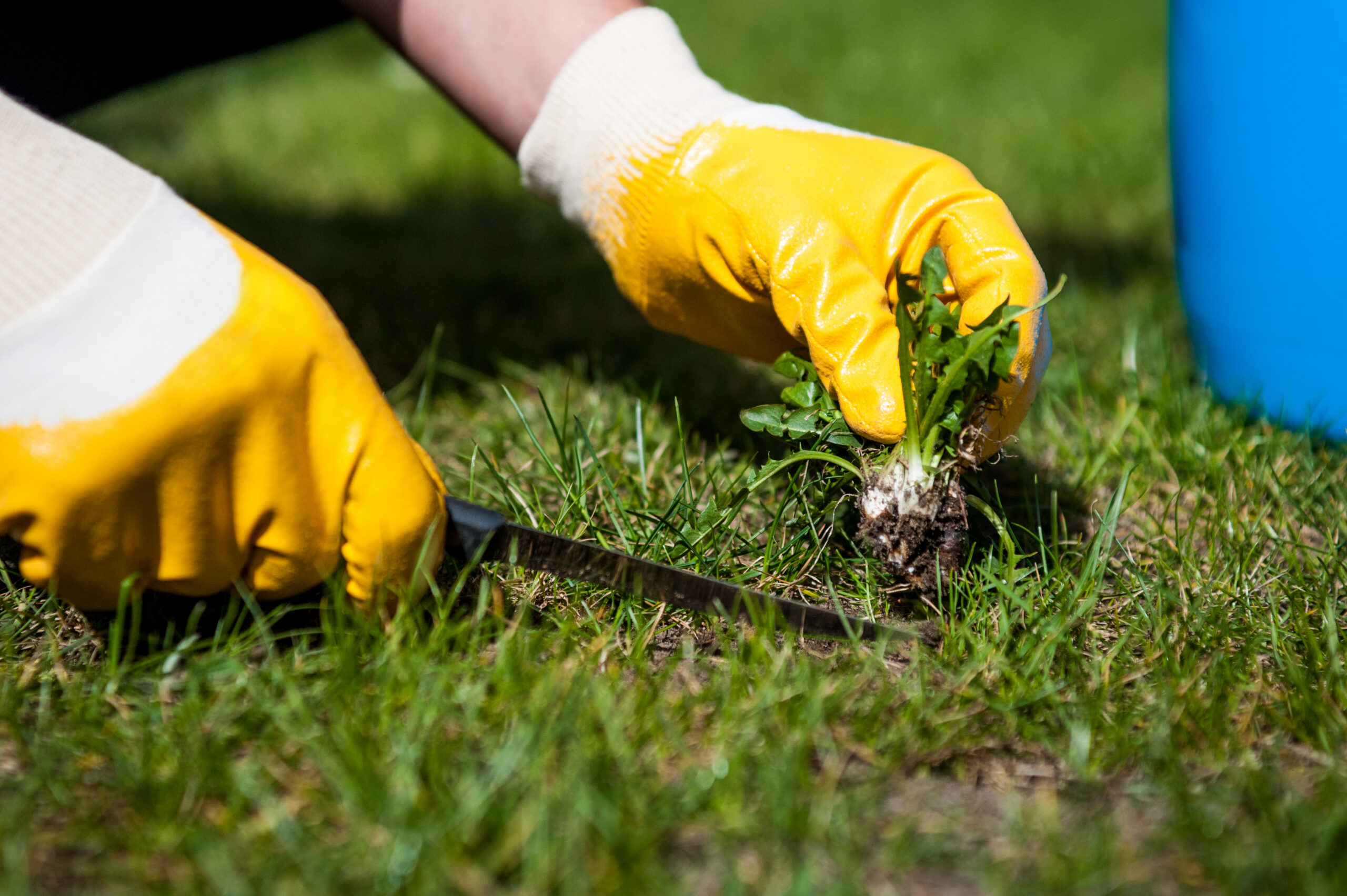
- Dandelion: Shows up in thin turf and compacted soil. Often a sign that mowing is too short. Deep taproots mean pulling must remove the whole root, or it will regrow.
- Crabgrass: Loves hot, sunny edges along sidewalks and driveways and lawns cut too short. Pre-emergent control in spring is key, along with taller mowing.
- Creeping Charlie, also called ground ivy: Spreads in shade and moist, fertile soil. If it thrives, your grass is likely starved for light or airflow. Improve light and use well-timed treatments.
- Clover: Often signals low nitrogen. Clover can fix its own nitrogen, so it wins in underfed lawns. A balanced feeding plan helps turf reclaim space.
- Plantain: Favors compacted, wet soil and heavy foot traffic. Core aeration and improved drainage reduce plantain pressure.
- Quackgrass: A perennial grassy weed with aggressive rhizomes. It spreads fast once established. It often requires non-selective removal and reseeding in small patches.
- Yellow nutsedge: Triangular stems, fast growth, and a love for soggy spots. Think low areas or overwatered sections. Drainage fixes are critical.
- Purslane and spurge: Thrive in dry, thin, hot soil. These are common in bare patches and along curbs. Thicker turf and mulch in beds keep them out.
- Thistle: Likes disturbed soils and open areas. Remove rosettes before they bolt and seed. Improve soil health to reduce re-invasion.
- Moss or algae: Not a weed but a clue. Tells you the area is shady, damp, compacted, or both. Improve drainage, raise mowing height, and increase light.
Why Weeds Spread in Patches
Microclimates and Traffic Patterns
Your yard is not uniform. The sunny strip by the driveway heats up more than the shaded area under a maple. Dog runs, mail routes, and kids’ play paths compact soil. Irrigation overlaps at corners while other zones miss water. These micro-differences give certain weeds the edge in some areas but not others. The Doctors of Landscaping analyzes these patterns during our site visits so we can tailor weed control to what your yard actually needs.
Mowing and Watering Habits
Mowing too short is one of the fastest ways to invite weeds. In southeast Wisconsin, cool-season grasses like Kentucky bluegrass, perennial ryegrass, and fescues perform best when mowed around 3 to 3.5 inches, sometimes up to 4 inches in summer. Taller blades shade the soil, which keeps it cooler and reduces weed seed germination. Watering matters too. Deep and infrequent watering, usually about 1 inch per week counting rainfall, encourages deeper roots and a thicker stand. Light daily watering favors weeds and disease.
Soil Health and pH
Healthy turf likes a soil pH of about 6.0 to 7.0. If the pH is off, fertilizer becomes less available and turf loses ground to weeds. Compaction limits oxygen and water movement, also hurting turf. A basic soil test tells you pH, organic matter, and nutrient levels. The Doctors of Landscaping can arrange testing and help correct imbalances with lime or sulfur, organic matter, and aeration. Fix the soil, and weed pressure drops.
A Weed Control Plan That Actually Works
Step 1: Identify Before You Treat
Correct identification saves time and money. A couple of quick checks go a long way.
- Look at leaf shape, flower color, and how the plant grows. Does it creep along the ground or grow upright?
- Check stems. Sedges have triangular stems. Grasses have round, jointed stems.
- Note location. Wet low spot, sunny curb, shaded backyard, or compacted path all narrow the options.
- Catch the growth stage. Young, actively growing weeds are easier to control than mature plants.
- Take clear photos and, if needed, ask a local pro. The team at the doctors of landscaping can help you identify weeds on site.
Step 2: Prioritize Cultural Controls
The best weed control is a dense, healthy lawn. Start with maintenance that gives grass an advantage.
- Mow tall, usually 3 to 3.5 inches, and never remove more than one third of the blade at a time. Keep blades sharp.
- Water deeply and less often. Aim for about 1 inch per week total. Water early morning to reduce disease.
- Fertilize at the right times. In our area, spring and especially fall feedings support thick turf that crowds out weeds.
- Overseed thin areas with quality seed that fits the site. Fine fescues handle shade. Bluegrass and rye favor sun.
- Core aerate compacted areas to improve air and water flow. Overseed after aeration for best results.
- Dethatch if thatch exceeds about half an inch. Excess thatch can harbor pests and block water.
- Topdress with a thin layer of compost to boost organic matter and soil biology.
- Mulch landscape beds with 2 to 3 inches of fresh mulch to block light to weed seeds. Avoid volcano mulching around trees.
- Edge along walks and drives to prevent turf from thinning at hot borders where crabgrass loves to sprout.
- Hand pull after rain when roots release more easily. Bag and remove seed-heavy weeds.
Step 3: Use Pre-emergent Wisely
Pre-emergent herbicides stop many annual weeds from sprouting. Timing is everything. In Kenosha, a good rule is to apply when soil temps reach about 55 degrees for several days, often early to mid spring. That window can shift with Lake Michigan’s cooling effect, so monitor local conditions. If heavy foot traffic or very hot edges are a problem, consider a split application, first in early spring and a second treatment 6 to 8 weeks later. Do not use most pre-emergents if you plan to seed right away. Ask The Doctors of Landscaping about timing or seed-safe options. Always read and follow the product label.
Step 4: Spot-treat Post-emergents
Some weeds break through even the best prevention. Spot-treat the right way for each type.
- Broadleaf weeds like dandelion and plantain respond well to selective broadleaf herbicides. Fall and cool spring days often give the best results.
- Creeping Charlie often needs a product with triclopyr, plus improved light and airflow. Multiple treatments may be needed.
- Crabgrass in its early stage is easier to control with specific grassy-weed products like those containing quinclorac.
- Yellow nutsedge needs ingredients made for sedges, such as halosulfuron or sulfentrazone. Fix drainage to prevent new outbreaks.
- In cracks and gravel, non-selective products or manual methods may be best. Use care to avoid drift onto desirable plants.
Always follow the label, watch wind and temperature, and consider working with licensed pros. The Doctors of Landscaping uses targeted applications and integrated practices to reduce chemical use while boosting results.
Step 5: Fix Edges, Beds, and Hardscapes
Weed seeds collect along borders and in hardscape cracks. Good design reduces that seed bank.
- Re-edge and refresh mulch annually. Two to three inches is enough. Thicker mulch can starve roots of air.
- Use fabric only under stone or gravel, not in planting beds where it can trap moisture and become a mess.
- Install polymeric sand in paver joints to block weeds and stabilize surfaces.
- Repair cracks in concrete or asphalt where seeds settle and sprout.
- Consider dense groundcovers in stubborn bed areas. Living mulch shades out weeds and looks great.
Common Scenarios We Solve in Kenosha Yards
Shade Lawn Overtaken by Creeping Charlie
We thin and raise canopy height with thoughtful pruning, overseed with shade-tolerant fine fescues, raise the mowing height, and improve drainage. We then time selective treatments, often in fall and again in spring, to knock back ground ivy while new grass fills in.
Hot Curb Strip Full of Crabgrass
We apply a pre-emergent at the right spring window, adjust mowing to the high end, correct bare edges with overseeding or sod, and dial in irrigation so the strip gets enough water without runoff. In summer, we spot-treat breakthroughs early.
Low Spot With Yellow Nutsedge
We solve the water problem first with regrading or drainage solutions, then use sedge-specific spot treatments while healthy turf fills in. Without drainage fixes, nutsedge returns. With them, the problem fades fast.
New Build With Thistle and Annual Weeds
Construction sites leave compacted, nutrient-poor soil that invites weeds. We loosen soil, add organic matter, correct grading, and install seed or sod. A simple maintenance plan holds the gains so weeds do not retake the area.
Seasonal Weed Control Calendar for Southeast Wisconsin
- Early Spring: Clean up beds, edge borders, and apply pre-emergent on time. Repair snowplow damage and salt-burned edges. Schedule core aeration if fall timing was missed.
- Late Spring: Spot-treat young weeds. Overseed bare spots if you skipped pre-emergent or use a seed-safe option. Begin regular mowing at a taller height.
- Summer: Water deeply and less often. Maintain high mowing to shade the soil. Control nutsedge and crabgrass while they are small. Keep mulch at 2 to 3 inches.
- Early Fall: Prime time for weed control on perennials like dandelion and creeping Charlie. Core aerate compacted areas. Overseed for a thicker stand before winter. Fertilize to build roots.
- Late Fall: Final cleanup prevents mats of leaves that smother grass and create bare patches that weeds will fill in spring. Winterize irrigation if needed.
- Winter: Plan improvements and schedule early spring services. The Doctors of Landscaping provides snow removal for residential and small commercial clients, which helps protect curbs and turf edges from damage that invites weeds next season.
FAQ: Quick Answers About Weed Control
Why do weeds return after I pull them?
Many weeds regrow from root pieces left behind, and most lawns hold a large seed bank waiting for the right conditions. Pull after rain, remove the full root, and improve turf density. Mulch in beds prevents light from reaching seeds, which reduces new sprouts.
Is organic weed control possible?
Yes, but set realistic goals. Cultural practices like tall mowing, overseeding, aeration, and mulch are the most effective organic tools. Corn gluten meal offers limited pre-emergent benefits when used correctly, but results vary. Boiling water and flame weeders can work in cracks, with care. Focus on soil health for long-term success.
How long does it take to see results?
You can see improvements in a few weeks, especially with proper mowing and a timely pre-emergent. Full transformation often takes one or two growing seasons. Consistency matters more than any single treatment.
Will new sod stop weeds?
Fresh sod gives you a head start, but wind-blown seeds still land on top, and edges are always vulnerable. Good mowing, watering, and a seasonal plan keep sod clean. Be cautious with herbicides on new sod until it is well established.
Do I need to treat in winter?
Lawns are dormant, so you focus on planning and protecting the turf. Avoid piling salted snow on grass. Schedule spring pre-emergent early so you do not miss the window. The doctors of landscaping can handle that timing for you.
Why Choose The Doctors of Landscaping for Weed Control
The Doctors of Landscaping is locally owned and operated in Kenosha, Wisconsin, with more than 30 years of experience. We started as a small lawn maintenance company and grew into a full-service provider because our community asked for one trusted team that can handle everything outdoors. Today we offer lawn mowing, edging, and clean-up; bed and planting services; patios, walkways, and retaining walls; seasonal maintenance with spring and fall cleanups; and snow removal for residential and small commercial properties. Our reputation is built on reliability, proper installation practices, and attention to detail. We show up on time, schedule efficiently, and leave your property clean when we finish. Clients choose us because we combine aesthetics with functionality and stand behind our work year-round.
For weed control, we do not guess. We identify the weeds, diagnose the conditions that led to the outbreak, and build an integrated plan. That plan includes maintenance adjustments, soil corrections, and targeted treatments when needed. The result is a thicker, healthier lawn that naturally resists weeds. You also get one dedicated provider for turf, beds, and hardscapes, which makes coordination simple. We provide free estimates, clear recommendations, and dependable follow-through.
Ready to Reclaim Your Yard?
If different weeds keep popping up in different places, your lawn is sending a message. The right weed control plan starts with understanding those signals and fixing the conditions that favor weeds. Whether you need smarter mowing and watering, core aeration and overseeding, precise pre-emergent timing, or expert spot treatments, The Doctors of Landscaping can help. Contact us today for a free estimate. We proudly serve Kenosha and nearby communities, and we are ready to restore your lawn’s health and curb appeal for the long term.

Leave A Comment